

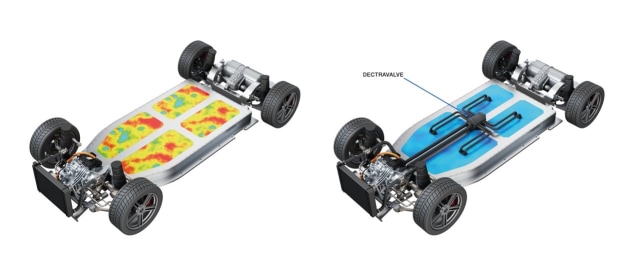
Hydrohertz, a leader in advanced automotive thermal management systems, has launched a world-first battery cooling technology which it claims not only delivers a step change in EV fast-charging times, but also significant improvements in battery range, life, and safety.
Hydrohertz’s breakthrough technology is the patented Dectravalve, a compact, intelligent, multi-zone valve system that delivers incredibly precise heating, cooling, or energy recovery of an EV battery.
“Optimising the operating temperature of an EV battery is crucial to both its short and long-term performance,” Hydrohertz CTO, Martyn Talbot, said.
“Unlike traditional systems which treat the entire pack uniformly, the Dectravalve system allows for targeted heating or cooling of individual modules within the battery. This means it can keep every part of the battery pack at a consistent, optimum temperature, maximising the performance of the cells across the entire pack.”
In an ultra-fast charging test with leading independent battery experts Warwick Manufacturing Group (WMG), a 100kWh Lithium Iron Phosphate (LFP) EV battery equipped with Dectravalve kept its hottest cell at under 44.5°C, maintaining a temperature difference of only 2.6°C across the whole pack.
This compares favourably to typical fast-charging conditions in today’s EVs, where peak cell temperatures regularly rise to as much as 56°C and the temperature difference across the pack can exceed 12°C. Once cells push beyond 50°C, charging power must be throttled to avoid ‘lithium plating’ (internal damage to cells) and long-term damage to the pack, meaning fast charging tapers off much earlier than advertised, significantly increasing the overall charge time.
In contrast, the Dectravalve-equipped battery never left the optimum high-power zone. It kept every module performing at peak efficiency, with no thermal weak spots holding the system back. Simply put, the Dectravalve-equipped battery stayed cool, even when pushed to its limits.
In the same test, Dectravalve demonstrated that charging times can be slashed by up to 68 per cent, meaning a typical 30-minute 10-80 per cent charge on a 350kW fast charger could drop to around 10 minutes, putting EV charging on a par with conventional petrol/diesel vehicle refuelling times.
And because the cells are operating at optimum temperatures during all conditions – i.e. not just when charging – the efficiency of the battery can be increased, delivering up to 10 per cent more real world driving range. With a typical mid-sized EV that could mean another 50-65 kilometres, providing more usable driving distance per charge, reducing EV running costs and energy consumption.
Safety is also significantly enhanced as maximum cell temperatures can be capped, preventing overheating, minimising risks of lithium plating (internal damage to cells) and thermal runaway (overheating leading to thermal incidents). And because the whole battery is operating at optimum temperature, Dectravalve can also extend its life, putting each cell under less strain so it can stay within a safer temperature range, protecting state of health (SoH) and enhancing overall lifespan.
Hydrohertz claims Dectravalve can optimise the performance of any EV battery – and future systems too. It is also incredibly cost-effective, bringing game-changing benefits for a fraction of the cost of developing an entirely new pack. Collectively, Dectravalve from Hydrohertz can help to transform EV useability, while also boosting residual values of used vehicles, and enhancing second-life potential of the battery pack at the end of the vehicle’s time on the road.
“The Dectravalve solves a fundamental problem of EV battery thermal management systems – how to achieve true independent zone control of temperature without the complexity, weight, and energy waste of multiple valve arrays,” Talbot said.
“Our innovation is elegantly simple: a single, digitally controlled unit that can manage four or more cooling zones separately.
“With Dectravalve, each cooling zone is completely independent, so coolant flows from the pump to the battery and back again in a specific loop. There are no unwanted, efficiency-sapping, leaks of warm coolant between zones.”